

Imagine that you have started a website and are on the verge of starting a new business online. But do you know if your “Contact Now” button is actually being clicked, or whether the creative videos you uploaded are really driving purchases? That is where the tracking code snippets like Facebook Pixel or Google Analytics come into play. They can be considered as the secret agents of your website, working behind the scenes to uncover what your visitors are really doing.
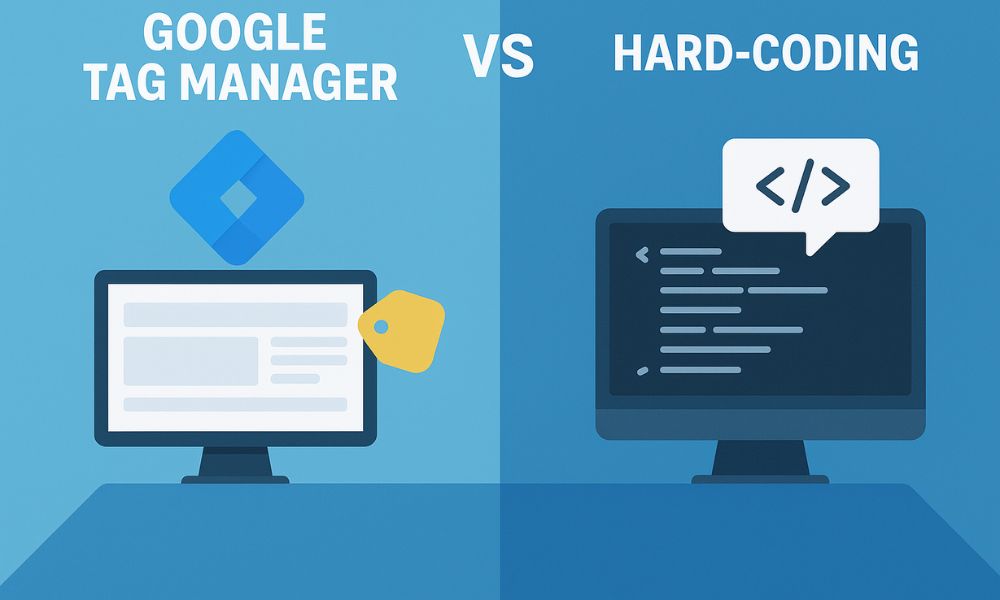
When we talk about the agents that serve the data and details regarding the websites, we should consider the traditional way and the modern way, which hard hard-coding and Google Tag Manager. This article acts as a guide for you to know more about both in determining which is best for tracking.
Definition and Application of Google Tag Manager and Hard-Coding?
Google Tag Manager
Google Tag Manager is a Tag Management System (TMS). It is a cloud-based platform that uses a single, container snippet of JavaScript code (the GTM container code) hard-coded onto every page of a website.
Hard Coding
Hard-coding refers to the practice of a developer writing tracking code directly into a website’s core source code files. Each tag is manually placed within the script tags of the website’s pages where it is needed.
(e.g., JavaScript snippets for Google Analytics, Facebook Pixel, etc.)
What do Google Tag Manager and Hard-Coding Offer?
Application of Google Tag Manager
The GTM container snippet is hard-coded onto every page of a site by a developer. Marketers and analysts use the GTM web console to configure “Tags”, “Triggers”, and “Variables”. When a page loads, the GTM container executes the rules and injects the specified tags into the page only when their triggers are met, ensuring a dynamic, event-driven process.
Application of Hard-Coding
The developer embeds tracking snippets into a website’s HTML structure, which is executed by a user’s browser. To change, add, or remove tracking tags, the developer must manually edit the code files, test the changes, and redeploy the entire website or page to the server. This process is static and predetermined. Hard-coding is similar to soldering components onto a computer’s motherboard, requiring a skilled technician, specific tools, and risks of damaging the entire board.
Example for Google Tag Manager and Hard-coding
Imagine you need a bookshelf for the growing collection of books can be a living example for the website’s marketing and analytics tool.
Google Tag Manager: When you get a new book, please don’t a carpenter, it is like when you have a new tag. It is like you have to rearrange what you already have
In Google Tag Manager, the developer initially installs a main frame onto your wall. This frame itself is the Google Tag Manager. Now your Books are like individual cubes that slide perfectly into pre-built spaces. Google Tag Manager is more like a modular and systematic library. Take one cube out and put another in. It’s flexible, fast, and you are in complete control.
Hardcoding: In hardcoding, adding a new tag, removing a tag, or tweaking one requires a professional, takes time, and costs money. If you want to put your shelf in another place, you will be left with holes in the wood. It is risky, rigid, slow, and inefficient.
Hardcoding is like building a library from scratch
Process: Every single time you buy a new book. For example, you want to add a Facebook pixel, and you have a skilled carpenter (your developer). They must get out their tools, cut new wood, and hammer nails directly into the existing structure to add a new shelf. This is the permanent bookshelf, which is the website code.
What’s the Difference Between Google Tag Manager and Hard-Coding?
Speed: In Google Tag Manager, you can add, remove, or update the tag and update it instantly by yourself. The overview for Google Tag Manager is that you don’t want to wait for a developer, but in the case of hard-coding, you need a developer for your site.
In hard-coding, Tags are directly added to the site by the developer. This highly reliable data collection for your most critical metrics.
Safety: The main structure of the website remains untouched. The risk of breaking the website is comparatively less as tag is arranged into different cubes. The overview is about Google Tag Manager.
In hard-coding, the codes are used because tags are baked directly into the source code and often placed strategically by a developer; they can be minified, bundled, and loaded without an extra network call to a third-party system (like GTM), which can, in theory, offer a minuscule performance advantage.
Power: GTM doesn’t just hold tags; it’s a smart system. You can set rules like, “Only put the Facebook Pixel cube on the shelf if someone visits the ‘Thank You’ page after buying something.
The implementation of every tag is directly visible, reviewed, and approved within the codebase itself through hard-coding.
What is the Advantage You Get When You Partner on Advanced GTM Use?
GTM is a tool that helps to manage basic tags, but its true power lies in tracking nuanced user behavior. It is a collective of scrolling interactions such as scroll depth, form abandonment, video engagement, outbound link clicks, and file downloads.
Advanced e-commerce tracking is beyond the technical advancement of a simple “purchase” tag to track the entire customer journey, including product impressions, clicks, add-to-cart events, remove-from-cart events, checkout steps, and transaction details. This provides a complete funnel analysis for optimizing sales performance.
Why a Strategic Planning Essential for Better Tracking?
An agency just doesn’t simply have the above-mentioned key features. The tracking needs to be accurate, comprehensive, and realistic, along with the requirements of the client. This helps in directly optimizing for making better business decisions. Viral Mafia, a Digital marketing company in Calicut, will help you to measure data directly impacting your business’s ability to grow.
Google Tag Manager offers marketing teams unparalleled speed, flexibility, and control for your websites. Having the assistance and guidance of the best Google Ads agency in Kerala will help your business with a great ROI. Viral Mafia is also a growing SEO company in Kerala, offering many services. Please visit the website or contact the details for further inquiries.
